Dani's Niche

Family history. A novel idea.


2 Comments

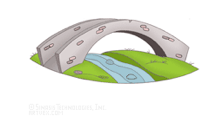
A Bridge

bridge_for_blogHe was seven years old. The moment he walked into my classroom on the first day of my teaching career, I feared it was going to be a long year. The wisp of a boy with a freckled face and set smile wore a faded Superman tee shirt that nearly matched his mop of curly red blonde hair. His large brooding eyes averted my gaze.

Before the end of the first week of school I had singled him out as the difficult child in my class. Doesn’t every class have one? No matter what he did, it annoyed me. He slumped in his chair gazing out the window, inattentive to my teaching. He did not turn in homework, and since he lost the first library book he borrowed, he was not allowed to check out another one. He spilled his whole box of crayons on the floor. Everyday. He could not sit still at his desk and talked out of turn. Clearly, no one had ever taught him about taking turns or obeying rules. The other children tolerated him but he had no close friend. And he smelled!

Sometimes the odor was so pungent I sent him to the office with a note for the secretary to find something clean for him to wear from the clothes box and give him a washcloth and soap to wash himself. After a while it became a weekly ritual.

He did excel at one thing. Reading. He progressed quickly through the levels of second, third and even fourth grade. During library time I noticed him in the non-fiction section perusing books like How Things Work and Building Things.

One day during a math lesson, Tanner sat at his desk flipping a piece of cardboard. I snatched it from him, scrunched it in my hand, and put it in my desk drawer intending to scold him during recess. I turned to him with a stern look, but he was not looking at me. He was looking at the floor.

Every Monday my students filed into the classroom at 8 o’clock and did their morning worksheet. Not Tanner. His head nodded and soon lay on top of his paper sound asleep. When I scolded him for staying up too late watching television, he just looked at the floor.

Three months into the school year, it was time to do our Thanksgiving project. I had the children draw self portraits and underneath write a list of things they were thankful for. The last bell of the day rang and all the children placed their creations on my desk and hurried out the door carrying their backpacks. All except Tanner. His head rested on his elbow, but I could see he was writing a few last words. Finally he got up and exited the room leaving his project on his desk.

I watched him walk out. Curious, I walked to his desk. His self- portrait was quite good. No one would question that it was Tanner with his uncombed red hair, freckles, and glazed eyes. Strangely, his mouth had a big toothless grin. I had never seen him grin. Under his self-portrait he had written:

I am thankful for …
my dad
my brij
books
a warm car
cukeez

The next word was smudged. Still damp. I think a tear had fallen there.

The list was not much different than those of the other children. But over the next two months I discovered a deeper meaning to the words he had written. I learned that sometimes he and his dad slept in a beat up car under the bridge with other transients whose drunken tirades on Sunday nights left him sleepless. They frequented the soup kitchen where Miss Rosie doled out homemade soup, bread and cookies. She always had a bag marked with a smiley face for Tanner to take “home.” “Home” was their place under the bridge.

I changed my mind about Tanner. Instead of seeing him as an annoyance, I began to look at him as a vulnerable little boy who needed hope. I wondered how I could give him that.

On Fridays I always chose one student to be Star of the Day, given as a reward for good behavior or excellent school work. Only Tanner’s name remained on my checklist. Could I find anything positive to praise him for in front of the whole class? Yes, true to form, he had spilled his box of crayons all over the floor and wiggled in his chair. But I did see him share his last cookie from Miss Rosie and take turns at the drinking fountain and though it was torn from many erasures, his book report had perfect lettering.

“Star of the Day is Tanner” I announced to the class, “because he did his best today!” I handed him a paper star with his name on it. When I looked at him he was smiling at me. I smiled back.

It was a long year, but a good one. Tanner is a third grader now. His teacher told me he and his dad will be moving to another state this spring. Another school, another bridge, another challenge.

As I was cleaning out my desk at the end of the school year, I found a piece of cardboard scrunched up at the back of the top drawer. I was about to toss the folded and taped object into the wastebasket when I noticed back crayon letters in Tanner’s rough printing. It read, “My Brij.”

According to the dictionary, a bridge is a structure built to provide passage over an obstacle. Tanner was my bridge. I learned more lessons from one little boy than I had taught my students that entire school year. I learned to look beyond outward appearance and smells and behavior. I hope one day Tanner will build real bridges. But for now, I think he’s doing a pretty good job.

=+=+=

This is not a true story but it could be. Inspired by and dedicated to the students and teachers who have touched my life.

Leave a comment

More Handwritten Treasures

No photographs exist of my great great grandparents when they lived in England in the early 1800’s. So, when I opened the autograph book of my grandmother’s sister, Lizzie, I knew I had found a treasure. Instead of a picture I had a sample of my great great grandfather’s handwriting and what was on his heart to tell his granddaughter.

In 1883 Richard wrote her: “My advise is to walk in wisdoms ways. The fear of the Lord is the beging of wisdom and understanding have thay that love to walk in wisdom. May the blessing of God go with you and gide and protect you and keep you from all Sin is the Desire of My hart.”

This was written by a man who could only place an X on his marriage certificate in 1832 because he was illiterate. I don’t know if he learned to read and write before he immigrated to America or after, but I do know he became quite proficient at both.

My great grandmother’s four lines in 1885 read: “May flowers of love Around thee be twined And sunshine of peace Shed its joys are thy mind.”

In 1888 Lizzie’s best friend Martha wrote: “A handsome woman pleases the eye; but a good woman pleases the heart.”

If you have handwritten treasures you’d like to share with readers, please click on the comment link above and I will post them.


1 Comment

Handwritten Treasures

(Last of five parts. Go back to “Grandpa’s Diaries” for the first.) 

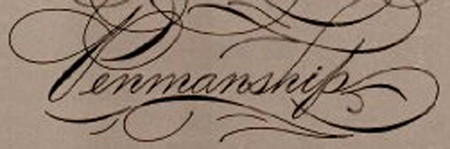
penmanship2Recently, a friend showed me a beautiful keepsake recipe book she designed for her family. Divided into sections like party time, dinner time, dessert time, each page pictures a relative, her favorite recipe and sometimes the food. What makes the book special is that the recipes are presented in the familiar writing of their loved ones.

Handwriting identifies a person by a unique style. Have you ever received a handful of mail and singled out a particular one because you recognized the writing of the one you were anxiously waiting for? Even people who lived a hundred or hundreds of years ago may be identified by their handwriting.

Did you ever gather signatures of classmates in an autograph book or yearbook? Did you push through a crowd with a scrap of paper or program to get the autograph of a celebrity or VIP? 

Why do people desire autographed books?  Shouldn’t we be satisfied with an ink stamped signature? Of course not! An autograph is a real signature. It gives value to a book, a letter, a scrap of paper. Even if it’s only sentimental value.

Handwriting is romantic. I’ll let you ponder this from your own experiences.

America’s Golden Age of Penmanship extended from 1850 to 1925. Penmanship used to be a subject for which students received grades. Teachers prompted them to draw circles like a Slinky across lined paper. My mother learned the Spencerian script with its ornamental flourishes. Even after the typewriter became popular, people valued Mother’s ability to elaborately script names on certificates, invitations, in books and Bibles.

Dad did not have Mother’s beautiful cursive writing and he did not write many personal letters or notes like she did, so I treasure the few I have. A few days ago I opened an old scrapbook and found one. He had written it on a scrap of paper at the airport just before my parents saw me off to Africa for the first time. He must have sneaked it into my purse for me to read once I was on my way. I’m sure it was an emotional time for them as it was for me when I discovered that precious treasure.

Children today learn to type before they can hold a pencil. We’ve even succumbed to the electronic signature. Penmanship has been devalued. 

In the future will we view a framed signature or letter on the wall and declare, “Isn’t that a beautiful piece of art?”


The Thought That Counts

IMG_2946_resized

I appreciate having a computer. Without it I never would have written a novel. And e-gadgets bring distant family members close when we share photos, skype and text. 

Electronic communication does not need envelopes, stamps or mail boxes. E-mails, e-cards, and texts are easy to store, easy to trash, easy to read, quick to type, quick to send and receive, easy to correct or change, and inexpensive. There are choices of fonts, emotions and colors. The minute a person comes to mind, I can pop a letter to her and with one click she receives it thousands of miles away. I love that I can stay close to family and friends around the world. Quick is good.

 Who cares that every email looks pretty much the same – stark and impersonal? Isn’t it the thought that counts? 

 For all its advantages, do we sometimes relinquish something precious by our use of e-communication? Could it be we forgo “that special touch?”

Keeping In Touch

“Keeping in touch” means “maintaining communication with someone.” That definition seems more impersonal than the idiom implies. Have letters become merely functional – to be read and disposed of rather than treasured? Touch involves physical contact. It is personal. Letter writing (as in paper & the postal service) takes time, care and touch.

 Letter writing used to require paper and pen or pencil. The writer needed to choose the most appropriate paper, perhaps one with letterhead, or bordered with flowers, a vellum, fragranced sheet, or note card. Or decorated with something to add “a special touch.”

 The writer attended to her best handwriting. More on this vanishing “art” in my next post.

 The writer gave thought to the right words without edit, thesaurus, spell or grammar check or the ability to correct. It took time. 

 Finally, the writer addressed and licked the envelope (or sealed it with wax) and affixed a stamp. She sent the missive by messenger or mail service, then waited and waited for a reply. 

 Imagine how a young woman might have felt when she was handed a letter and her eyes fell upon the familiar handwriting of the one she loved. Personal notes and letters used to be cherished, to be read and re-read, stained with tears. Or blood. Or coffee. Bundles of yellowed love letters found in old trunks still spark our imagination and evoke emotion. 

IMG_2945_resized

 Recently I found the cards sent to my parents celebrating my birth because my mother pasted them in a scrapbook. Why did she do that? And why do I keep them?

 There is something special about touching a letter that has been written by a loved one or someone from the distant past. What does “keeping in touch” mean to you?

 I will continue to use a computer and welcome e-cards and letters, but I will cherish the handwritten notes. One day I will bring the special ones I’ve saved out of storage and remember when it was more than the thought that mattered. 

 And now, I’m going to take pen in hand and write a note to someone I love.


Letters from Africa

IMG_2871_web2When I first arrived in Africa I started a journal which, in a short time, fell by the wayside. Instead, letters sent home became a kind of diary because Mother saved and numbered every one that survived the long journey. Twenty years of letters fill a box, waiting for Someday.

Back then, without phones or computers, letters were our only connection to home. I bought stacks of pre-stamped aerogrammes that folded into themselves to make a tidy letter. They remind me of past centuries when letters were folded and made into their own envelopes.

The writing was tedious and so was the waiting. Mail by boat took months, by air a week or two. Sometimes packages and letters did not arrive at their destination.

Receiving letters was a highlight of the week. When the mail bag arrived we spent the rest of the day catching up on news from home and delighting in months old magazines. We welcomed any news to keep us connected, but what Proverbs 25:25 says is so true. “As cold waters to a thirsty soul, so is good news from a far country.”


My Diaries

IMG_2868_web1My first diary was a gift for eighth grade graduation. Through high school and university I faithfully filled its pages and started another. Like my grandpa, who kept diaries a century before (see previous post), my entries focused on people and events rather than reflections.

Recently I found my diaries buried in a picnic basket of memorabilia. After a glance at a few entries I upgraded their position to the top of the collection and shut the lid. For another day.


Grandpa’s Diaries

harvester with old RaveGrandpa was a farmer. In the 1800’s he grew wheat where sheep grazed and it was not long before others started to plant grain. He bought land on the other side of the river and planted almond trees. In a few years, the hills came alive with pink blossoms in spring and the town became the “almond capital of the world.”
Grandpa came from northern California to the central coast when he was 25 years old. By the time my dad was born Grandpa had moved the family from the farm into a two story Victorian in town. He ventured into business selling farm implements, and when Ford started to mass produce cars he opened one of the first dealerships.

I only knew Grandpa as an old man with a full head of dark hair who sat me on his knee to tease and give me pony rides and who made sure I was quiet in church. I don’t remember any of it because Grandpa was buried when he was 91 and I was only three. Photographs and stories my Dad told were my only connection to Grandpa. Until I found his diaries.

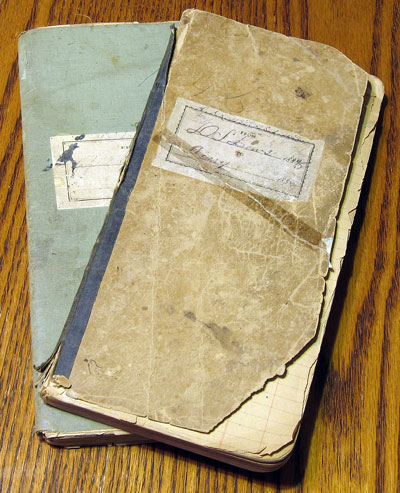
I can’t sit on Grandpa’s knee and listen to his deep voice or hear his hearty laugh. But he speaks through his faded penciled words.IMG_2866_web1

The first entry is dated Oct 25, 1886 and the last July 4, 1906.
Random entries:
Trim trees. Kill little pig.
Plow in pasture 1 team sold heifer to Dick N.
Sunday at church.
Mr. Smallman, wife and baby came out, staid all night
Rain at night
Plow 2, 10 horse teams

He wrote of deaths including this poignant one:
Went to ranch after milk in afternoon… Had supper, put Lizzie (his wife) to bed at about eight o’clock …Went to bed about nine thirty. Lizzie awakened me at fifteen minutes past eleven with a hemorage which “drowned” her in about five minutes.
A month later he wrote Ma unconscious all day. Died at six o’clock.

Sometimes I’ve learned about him by what he did not include in the diaries. In 1905 he wrote:
Oct 18 Joe tore old paper out of two rooms
Oct 19 John is burning trees on summer fallow.
Oct 20 Joe is papering. Baby boy was born half past four.

Grandpa recorded the time of birth but not the name of his only son, my dad. There don’t seem to be any more entries about him. Farming was what Grandpa did. He left the babies to Grandma.

For now Grandpa’s diaries sit on my bookshelf. Someday I will learn more about farm life in the 1800’s and more about Grandpa.