Dani's Niche

Family history. A novel idea.


Leave a comment

Would You Cross Here?

2016-02-26-0001

Getting to a village in Africa usually meant turning off a dirt road and driving through areas of scrub bush, weaving around thorn bushes, boulders, and across sandy, muddy, or swollen rivers. Signposts were trees, a rock outcrop, or a lone mud-walled duka.

With so many thorn trees, punctured tires were common. After a rain my little VW sometimes got stuck in deep, sticky mud or slid across a road of slick, black cotton soil. My biggest fear was getting safely to the other side of a flowing river or muddy stream. If I attempted to cross, would my car and I be swept downstream or swallowed by thick mud?

Was the water flowing fast and high? Had other vehicles like mine safely crossed in the last few minutes? Were there people I could ask? Should I change direction and go another way? If there was no other way, should I wait or return to where I started?

On one occasion a man stood in the river waving me on. My hands gripped the wheel and I focused on my guide who walked ahead on a submerged concrete slab. I did not turn my head to look upstream or downstream at the flowing water. Once I committed there was no turning around. I just kept moving slowly forward, praying my car would not stall or slip off the narrow slab.

God allows us to make choices on the road of life in which there are many crossings. Do we rush into the water without counsel or asking questions? Do we test the waters, then choose to risk what we know is a bad decision? In that case we might begin the crossing, then realize our foolishness but can’t turn back. We must suffer the consequence.

Unlike crossing a river in Africa, in life there is always One who knows what is best. Sometimes we must go through deep waters. The Lord waits to guide us, for us to trust His direction and His promises.

Isaiah 43:2  (KJV) When thou passest through the waters, I will be with thee; and through the rivers, they shall not overflow thee …

James 1:5 (KJV) If any of you lack wisdom, let him ask of God, that giveth to all men liberally, and upbraideth not; and it shall be given him.

Deut 31:8 KJV And the LORD, he it is that doth go before thee; he will be with thee, he will not fail thee, neither forsake thee: fear not, neither be dismayed.

Proverbs 11:14 KJV Where no counsel is, the people fall: but in the multitude of counsellors there is safety.

VW crosses Kenya  river 81


Leave a comment

Beauty in the Darkness

This month my friend Helena Weltz shares a personal story. We met as young, single teachers at a girls’ secondary school in Kenya. Later she moved to a remote desert location where she taught children and adults to read and write. She also held sewing classes for mothers so their children would have clothes to wear in school. Now living in Canada, Helena enjoys crafts, sewing, knitting and writing. Always ready to help and encourage others, she and her husband lead a grief support group. This story is one of many lessons she learned in Africa.

night-blooming flower

It was dark as we walked along the path on our compound. No street lights or yard lights illuminated the footpath, but the starry sky was bright with a nearly full moon. My co-worker, Bertha, experienced and knowledgeable in many aspects of the tropics, had brought her flashlight along with a camera.
Earlier that day Bertha had noticed that the night-blooming shrub, not far from our house, had buds on it; one bud looked ready to come into full bloom. I am not sure whether it was a moon flower plant or an angel’s trumpet. No one seemed to be certain of its name. Now we were on our way to view beauty in the darkness. Bertha shone the bright flashlight in the direction of the plant. Yes, there was the flower – white, large and fragrant. The bloom was perhaps four or five inches across.  We admired its silent, inconspicuous beauty.
The next morning as I walked to class, I stepped over to take another look at this plant. The only sign that there had indeed been a beautiful blossom was a small withered, closed vestige of a flower. It was hard to comprehend that it had been gorgeous and appealing just hours earlier.
I wondered if this plant had wasted its fragrance and its beauty. Quite likely Bertha and I had been the only ones to witness this one-time occurrence of its blossoming. Any of its flowers bloomed only at night and only one night. I began to think that this night-blossoming plant in its quiet, unassuming manner had a lesson to teach us:
First, our God is a God of beauty. Even if none of us had witnessed this plant in full bloom. God, who sees all things and has created the flowers of the field, must surely have enjoyed this delightful sight, His own creation.
Second, God has given us gifts to develop, to stretch and to unfold. My giftedness may not be sensational or spectacular, but just as God asked Moses to use his less than eloquent manner of speaking, he did great things with what God had given to him. I believe God expects me to use my gifts to the best of my ability to serve Him. The wise man, Solomon recorded, whatever your hand finds to do, verily, do it with all your might; (Eccl. 9:10)
We used to sing a little song in Sunday school that encouraged us to do our best even if it is in the darkness:

Jesus bids us shine, with a clear, pure light.
Like a little candle burning in the night;
In this world of darkness we must shine,
You in your small corner and I in mine.


2 Comments

Tattered and stained.

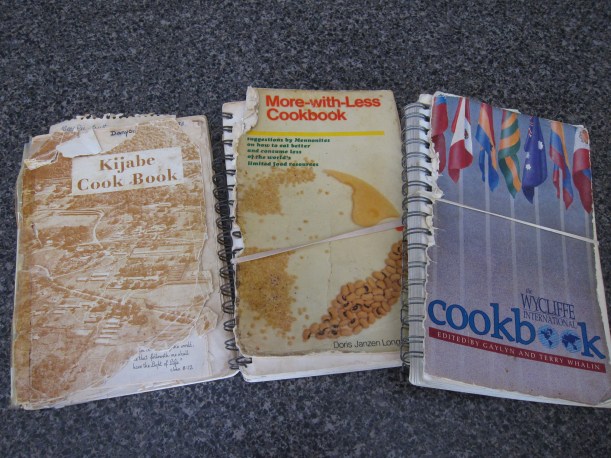
missionary cookbooks

Our neighbor gave us lemons. So, though I don’t bake much anymore (for healthier living), I pulled a cookbook off the shelf for a lemon bar recipe. Tattered and held together with a rubber band, it and two others were mainstays in my kitchen for many years in Africa. They are unique cookbooks because their recipes call for simple, basic ingredients. I depended on them when we had no access to processed or pre-packaged foods I now take for granted. Nowadays I go to them for favorite or international recipes.

When I open these books I see smudges and stains, and like perusing an album of memories, I recall special events, calamities and critters in the kitchen, friends, and much more of my life in Africa.

These cookbooks bring to mind the time when I had to live with less, making do with what we had. Today I have more and must choose to live with less. My neighbor gave me lemons, so now I’m going to get busy making those lemon bars to share.


2 Comments

A splash of color on stone

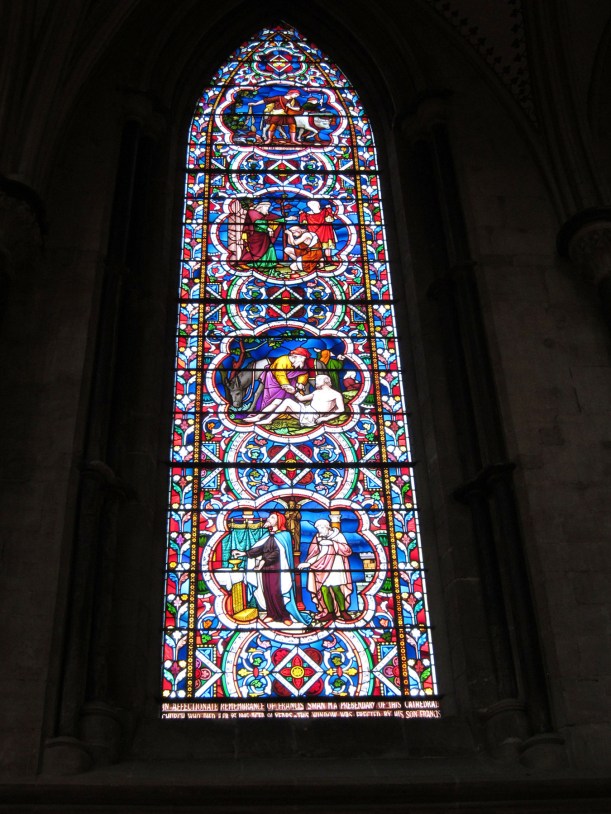
Lincoln Cathedral from Castle Wall croppedLincoln is a beautiful city in Lincolnshire, England, with history dating back to the Romans. The castle and cathedral, at the top of Lincoln Cliff,  are the centerpieces of the historical section with its narrow cobblestone streets, tiny shops and famous Steep Hill.
The well-preserved castle remained in use into modern times as a prison and a court. Visitors may view one of four Magna Carta originals or walk along the stone walls for a panoramic view of the countryside, the castle complex and the cathedral. (The above photo of the cathedral was taken from the castle wall).

Lincoln Cathedral_sizedOf the cathedral, Victorian writer John Ruskin said, “I have always held… that the cathedral of Lincoln is out and out the most precious piece of architecture in the British Isles and roughly speaking worth any two other cathedrals we have.”

One day, as we topped the hill on foot, we wondered at the beautiful singing wafting toward us. It was Evensong on Ascension Day at the cathedral. We entered through huge wooden doors into the nave, its stone floor bare of furniture but splashed with color. Compelled to seek the source of the color, I turned and gazed upward at a large arched window. Pouring through intricate pieces of colored glass, the sunlight brilliantly lit a pane of  biblical scenes.

reflection of stained glass window_sized
We are made in God’s image to be reflections of His glory. If we know His saving grace, then in trials we reflect Christ’s strength and peace. In temptation, we reflect His power and righteousness. In times of blessing, we reflect His graciousness. Like a splash of color on stone, our lives may not seem significant, but they should reflect the One who gives life.

But we all, with open face beholding as in a glass the glory of the Lord, are changed into the same image from glory to glory, even as by the Spirit of the Lord. 2 Corinthians 3:18 KJV
Lincoln Cathedral Stained Glass_cropped


Leave a comment

Ice cream in Africa-A team effort

making ice cream Africa

Making ice cream in Africa meant planning well ahead. It took lots of ice, so we all had to contribute. A pan of ice took up precious space in the tiny freezers of our kerosene fridges. We usually didn’t have cream so used powdered or UHT milk. One time, after a lot of work, we sat down to enjoy our luscious treat. Sadly, we had to throw it away for some of the rock salt had gotten into the milk mixture. As you can see from the photo, it was a team effort.  That’s our headmistress Joyce on the left taking her turn at the crank, nurse Edith standing on the machine, and  Helena lending a hand. I am on the right with Bretta and the other ladies crushing ice. A lot of work for a few spoons each of ice cream and a fond memory.


2 Comments

Grandpa’s Diaries

This was my very first blog post two years ago. I just added the photo of Grandpa and his harvester.

kyomegirl's avatarDani's Niche

harvester with old RaveGrandpa was a farmer. In the 1800’s he grew wheat where sheep grazed and it was not long before others started to plant grain. He bought land on the other side of the river and planted almond trees. In a few years, the hills came alive with pink blossoms in spring and the town became the “almond capital of the world.”

Grandpa came from northern California to the central coast when he was 25 years old. By the time my dad was born Grandpa had moved the family from the farm into a two story Victorian in town. He ventured into business selling farm implements, and when Ford started to mass produce cars he opened one of the first dealerships.

I only knew Grandpa as an old man with a full head of dark hair who sat me on his knee to tease and give me pony rides and who…

View original post 293 more words


4 Comments

Peering through Great Great Grandmother’s Eyeglasses

GGGrandma Catherine Humphrey Horn 1802-1871, eyeglasses

I didn’t know what to expect when I opened the metal container. It was very small as were the reading glasses inside. They belonged to my great great grandmother Catherine, born in 1802.

The side bars were straight so they wouldn’t hook over my ears. A brown ribbon was attached to the holes at the ends of the bars. I still haven’t figured out how it was meant to keep the glasses on.

Viewing the hymnbook and glasses together in the photo gives the impression that both are larger than they seem. Actually, the book is only 2 by 4 inches so the print inside is tiny. No wonder people in the 19th century needed reading glasses.

The Past
I lifted the lenses to my eyes. Blurry. Yet I was able to see through them.What if I could view the past through Great Great Grandmother’s glasses? What if I could see what it was really like back then?
As a writer of historical fiction I look at old photographs and other artifacts, read stories handed down through the generations, and research culture and historical events. It’s like looking through old glasses. Not a clear view but enough to get a feel for life long ago.

The Future
What if I could view the future? God gives us a peek at the future in his word, the Bible, especially in the books of Daniel and Revelation. “Now we see through a glass, darkly; but then face to face.” (I Corinthians 13:12 ) My view now is dim; I have limited understanding, but one day I will see clearly.

The Present
My vision in the present isn’t perfect either. It has diminished with age. Some of my younger friends are near-sighted or far-sighted. I am thankful for corrective lenses which help us see more clearly.

We all lose focus at times, become short-sighted or too far-sighted, even blind. God offers his word for correction. “All scripture is given by inspiration of God, and is profitable for doctrine, for reproof, for correction, for instruction in righteousness.” (2 Timothy 3:16) He can also make the blind to see. “Then Jesus put his hands on his (the man’s) eyes again; and he opened his eyes, his sight was restored, and he saw everything clearly.” (Mark 8:25)

To keep a clear focus I need to continually“look unto Jesus the author and finisher of our faith; who for the joy that was set before him endured the cross, despising the shame, and is set down at the right hand of the throne of God. (Hebrews 12:2)

Be Thou My Vision
This traditional Irish hymn is my prayer for perfect vision. Is it yours?

Be thou my vision, O Lord of my heart;
Naught be all else to me, save that thou art;
Thou my best thought, by day or by night,
Waking or sleeping, thy presence my light.

Be thou my wisdom, be thou my true Word;
I ever with thee and thou with me, Lord;
Thou my great Father, and I Thy true son;
Thou in me dwelling, and I with thee one.

Riches I heed not, nor man’s empty praise,
Thou mine inheritance, now and always;
Thou and thou only, first in my heart,
High King of Heaven, my treasure thou art.

High King of Heaven, my victory won,
May I reach heaven’s joys, O bright heaven’s sun!
Heart of my own heart, whatever befall,
Still be my Vision, O Ruler of all.

(lyrics attributed to 6th century poet Dallan Forgaill, later translated to English)


6 Comments

Dad’s Dazzling Victorian

Screen shot 2015-12-07 at 1.06.02 PM

Victorian at Christmas

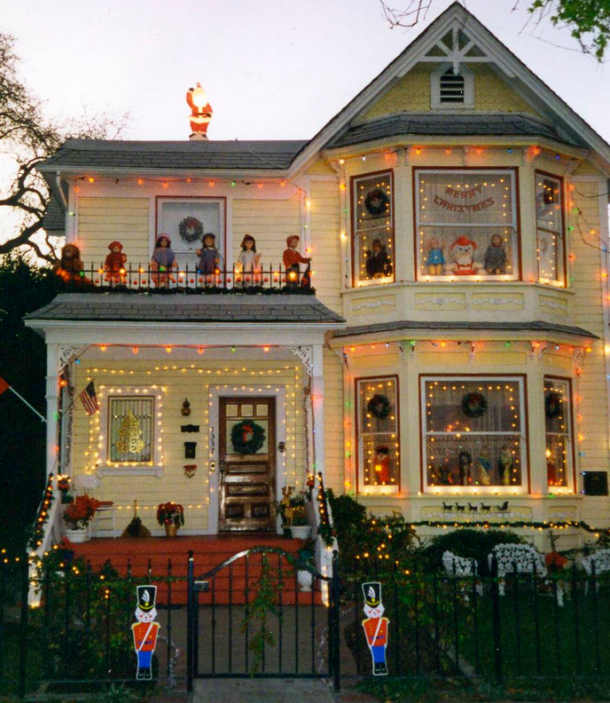
The two-story Victorian was built in 1889. My parents bought it almost hundred years later, after Dad retired from teaching. Mother had always admired the old house. Dad had a special plan for it, at least for one month of every year.

A born entertainer, he loved to elicit laughter and smiles.  He was a vocalist, marimba player, ever ready with a trick or a funny story for young and old.

Dad purchased strings of colored lights, extra bulbs, extension cords and power strips. He drew a schematic to show where the thousands of lights would be positioned and safely plugged in.

The morning after Thanksgiving he started hanging the lights. Mother helped organize dolls from her vast collection. Dad fashioned a star, then climbed up as far as the ladder reached to attach it to the palm tree letting strings of lights flow down its trunk.

After weeks of preparation, last to be placed was Santa. Dad put the ladder on the second floor widow’s porch. Bystanders gasped as he climbed up and secured the big prop to the rooftop.

At 6 pm on the second Saturday of December, Dad flipped the switches and the stately aged house transformed into a kind of fantasyland, alive with color, twinkling lights, wise men seeking Jesus in the big bay window and dolls in every window, ledge, porch and yard. Children squealed with delight when some of the dolls seemed to come to life and when they spotted Santa on the housetop.

But Dad was not finished with his gift to the community. Dressed in a long wool coat and scarf and wearing a top hat, he made his way out the front door and down the steps. He took up mallets in both hands and tapped out Christmas songs on the wood bars of his marimba. No matter the weather he entertained outside for three straight hours. Sometimes he stopped playing to say “Merry Christmas” to those crowded along the fence or delight them with a mechanical monkey from his boyhood.

For many years townspeople and visitors from afar gathered by the thousands to walk the street to view all the houses lit and decorated for the season, to sip apple cider and taste roasted chestnuts, to listen to the carols and pause in silence in front of the nativity scene.
Screen shot 2015-12-07 at 1.06.45 PM
Mother passed away in the morning a few weeks before Christmas one year. By afternoon Dad was out stringing lights. My husband, thinking the loss would take away his desire to tackle the huge project, said, “Don’t worry, we’ll help you.”
“What?”
“We’ll help you.”
“I’m okay,” he said and proceeded to wrap his house in light. It was his gift of joy, even in sorrow.

Dad was 98 years old when he decorated the house for his last Christmas. As always, he insisted he was the one to put Santa on the roof.

This week I looked at old photos of the house in its holiday glory and thought about Dad. No lights needed on his mansion in heaven. The light of even a billion stars will surely seem dim compared to the light of the glory of God. I can’t imagine it!


Leave a comment

Country Road

Inspiration does not come from my computer screen.
Ladera fence
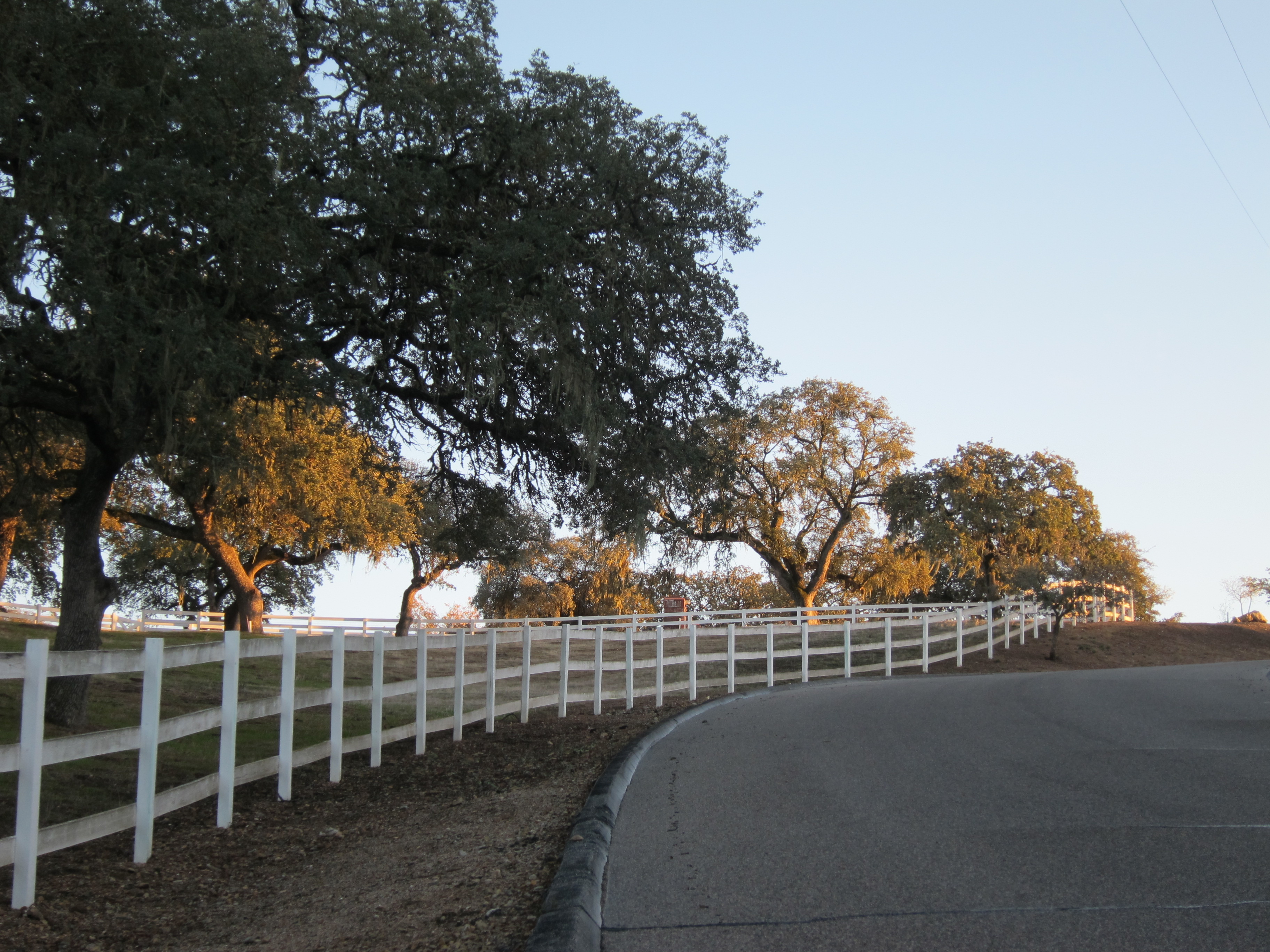
The cool morning air slaps my face when I open the front door to start my daily trek along the country road. Pausing at the top of the first climb I view the hills in every direction and lift my head to the warmth of the sun.

Clouds float past, a procession of various shapes and forms. Birds ebb and flow and morph into shapes as they journey to their destination. Vultures swoop and hawks soar.

Birds twitter and rustle in a huge oak while mourning doves coo and mocking birds mimic. A woodpecker hammers against the telephone pole.

I breathe in the fragrance of honeysuckle, smoke, and wet pavement after a rain shower.

A deer bounds across the road while a tarantula marches down. Foxes, snakes, squirrels, cottontail rabbits and cats sometimes cross my path and I am wary of the elusive mountain lion. Horses and goats graze behind fences.

I contemplate God, His creation, His love and grace and mercy.
I pray for guidance.

Ideas flow–beginnings and endings, dialogue, plot and conflict resolutions.

When I reach home I am ready for my mission.

I have a message to share.

I am a writer.


Leave a comment

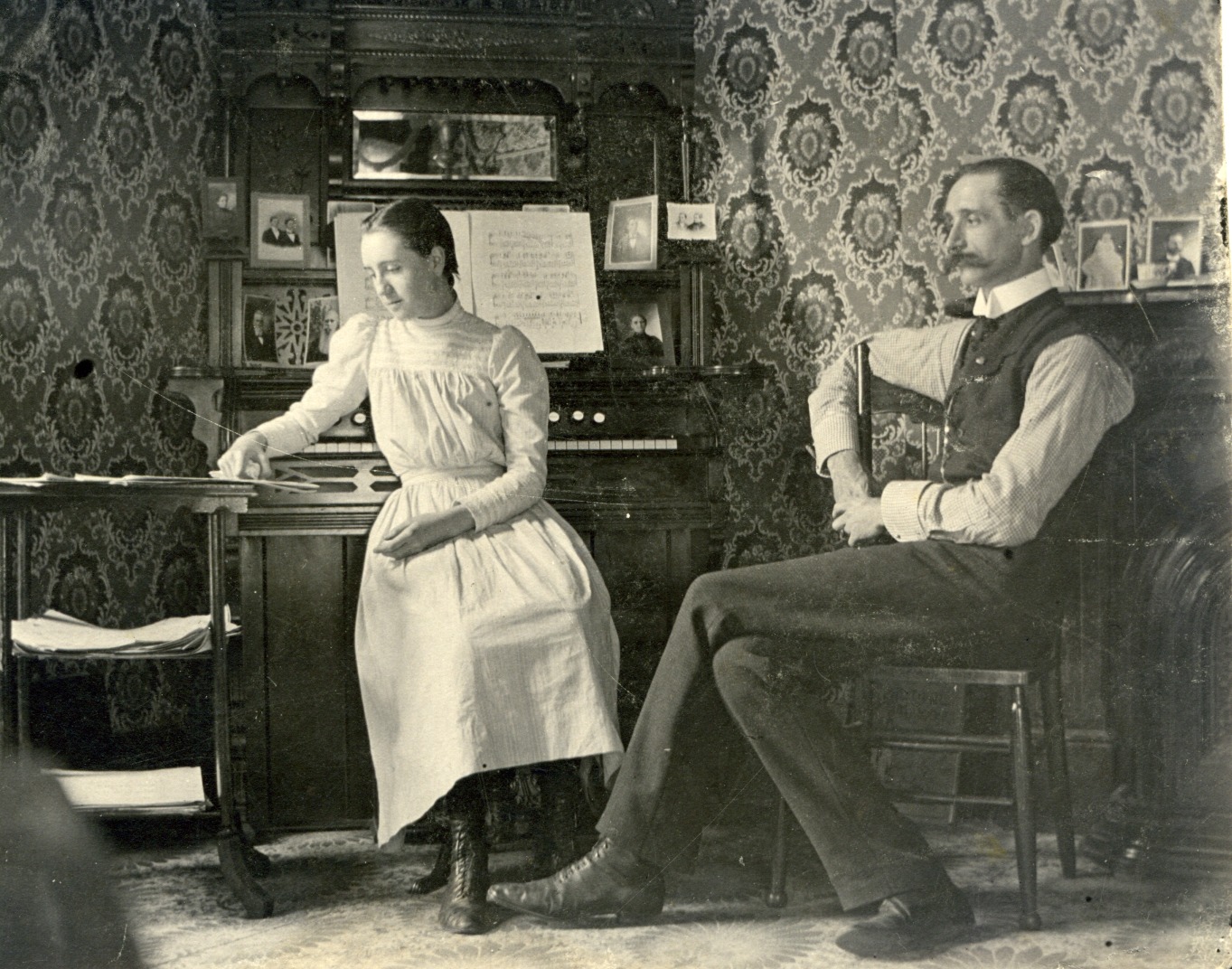
Every Photo Has a Story: The Pump Organ

pump organ photo

Great Grandfather Amos made sure his children attended singing school because music was important, even if they only had their voices for making it. That changed one day in the 1870‘s when he hauled a pump organ by wagon from Madison to the farmstead. Also known as a reed organ or harmonium and sometimes a parlor organ, its sound was generated with a bellows. There were knee stops to control volume, foot pedals and a row of stops to push and pull to change the tone from flute to orchestral forte or echo to clarinet and other instruments.

Their daughter Lizzie was the first and most proficient at learning to play the hymns and other songs. When she finished teachers’ training and set out to homestead a 160 acre government claim in Dakota territory, Amos made sure she went with her own little pump organ.

The photo, which could be entitled “The Music Lesson,” was among my dad’s papers but is not of family. It portrays a girl likely with her teacher and lots of sheet music. Great Grandfather’s organ, unlike this elaborate one, was more portable with a low back and plain in design though it produced a good tone. Amos’ children taught themselves to play instruments and did not follow notes on paper, at least at the beginning. Two of the boys were good with the violin and later one sold violins in his store. I imagine the family spent many evenings, especially during the Wisconsin winters, making beautiful music around the organ.
There was another pump organ, one my parents brought home when I was about ten. Dad told us it had come across the U.S. to California in a covered wagon one hundred years before. Having read of the long hazardous journeys of the westward movement, I wondered how it survived in such good condition. And why would anyone have used the space for a 400 pound extravagance?pump organ:Lewis kids519
My sister and I, piano students, quickly took to the new instrument. Pushing the knee stops and pumping the foot pedals was tiring, but I was fascinated with the different sounds produced by pushing and pulling the stops. Time seemed to fly as I sat on the hard, round three-legged stool that swiveled to just the right height so my feet could reach to pump the foot pedals while my hands pressed keys.
The organ became the focal point of our living room and one year Dad featured it on our Christmas card. My sister was determined to be pictured as the organist but being the oldest, I was given the privilege of posing on the stool.

A fond memory from my childhood is my family making music together, several generations gathered around the piano or organ singing songs from past generations. It was fun and we were together and that is what mattered.


Leave a comment

Every Photo Has a Story: Great Great Grandma’s Sunbonnets

Margaret (Maggie) Dugan with chickens1909 KansasSeveral faded photographs, three sunbonnets, and a list of items sold at auction.
My sister and I did not know much more about our great great grandmother. Taking a clue from the writing on the back of the photo of Great Great Grandma and her chickens, my sister and her husband took a detour on their vacation trip from the west coast. Near the borders of Nebraska and Missouri, they followed a stretch of scenic highway across the Great Plains of northern Kansas to Willis, Kansas where Great Great Grandma Maggie had a farm over a hundred years ago.

In 1883 William G. Cutler published his History of the State of Kansas one year after Willis began as a station on the Missouri Pacific Railroad. He had high hopes when he wrote, “It is already a thriving young town with a number of enterprising citizens, who do a good deal of business. It has two handsome churches, several stores and a number of fine residences, and bids fair to soon become one of the important towns of Brown County.”

Willis never grew much after the turn of the century. Today it is barely a dot on the map with only 38 residents. A few houses of different eras stand on quiet streets. Some sport neatly kept lawns and colorful flowers, porch swings and the American flag. Others lie in disrepair. An orchard of fruit trees has seen better days.

Raised letters over the doorway of a handsome one story brick building reads Public School Willis 1912. Where students once entered double doors, windows are boarded and it stands derelict in a field of tall prairie grass. A large section of roof on the once sturdy high school has collapsed into the second floor. With no reason for upkeep, worn and rickety buildings seem destined for the woodpile.
Even with patches of peeling paint, a two story Victorian retains its stately beauty, reminding us of a more vibrant time when the town served a community of small farmers. The friendly proprietors of Teeter Totter Antiques (which you’d miss simply passing through) are proud to share the history of Willis.

It once boasted three grain elevators. The first business was a furniture store and in 1884 there were two churches, 3 drug stores, 4 groceries, 3 dry goods, a lumber yard, meat market, bakery, hotel, blacksmith, barber, shoe shop, a shooting gallery, hotel and more. A few years later it had its own newspaper. The town was laid out with streets and sturdy two story buildings like Trompeters Block which sold hardware, farm implements, drugs, dry goods and groceries.

Willis represents hundreds of Kansas ghost towns, once vital farming communities, spread across the entire heartland of America. Today they are but links to the past, like revered museum pieces. Willis is part of my history and that’s how my sister and I discovered it.

We never knew my Irish American Great Great Grandmother Maggie. If she was anything like her daughter, my great grandmother who I do remember, she was slim but feisty and strong in mind and body. She was born in 1856 and married an Irish American blacksmith when she was only fifteen. After 22 years and three children, her husband died, leaving her to raise the children. Nine years later she married a slightly younger man, a widower with three children, the youngest only three years old. They were married over thirty years until his death.
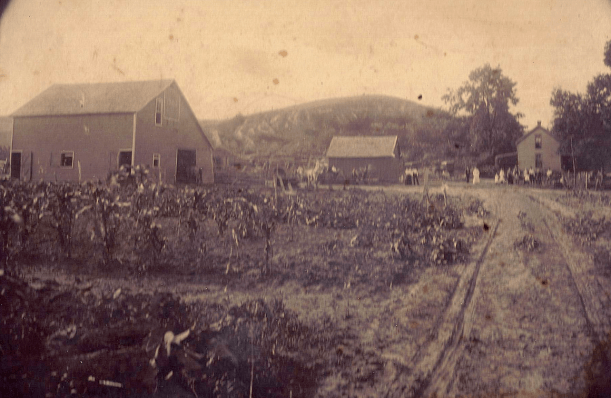
Screen shot 2015-09-02 at 12.51.16 PMThe following is a partial list of items sold at auction on Dec 8, 1919 as shown in the photo of their farm. The full account includes the buyer. To me it is more than a list; it tells us about life in the early 1900’s.
wagon $26
old buggy $25
new buggy $75
harrow $14.50
riding cultivator $31
Preserves- 30 cans of cherries @ 29c each, 8 cans of tomatoes 10c each
sewing machine $25
range $54
2 mules @ $70 each
1 brown mare $18
a bay horse $28
jersey cow $142
black and white cow $100
1 red heifer $50.50
1 black and white heifer $30.50
1 bull calf $25
1 heifer calf $17
5 pigs $20 each
1 boar $15
All their dishes, chairs, tables, cooking and washing utensils, hay, harnesses, collars bridles, lanterns, double trees were listed.
Total income minus fees was $1203.54

Typical of farm families, they tended a large garden with vegetables. Maggie canned fruit and made preserves from their orchard. She might have taken some of the tomatoes and corn to the local cannery. They had milk and cream from their dairy cattle. Chickens supplied meat and eggs. James hunted rabbits with his friends. They raised pigs and kept horses and mules for pulling the plow, harrow and cultivator on land where they grew wheat, corn and sorghum. Maggie made clothing from flour and feed sacks and old clothes. They learned how to get by with very little money.

In 1920 they sold the farm and most of their possessions and moved to Southern California with the little they could carry. They might have traveled by train from Kansas City or perhaps with the money from the farm they bought a Ford (if by then the price had been lowered to $260 leaving enough for gas and a house when they got to their destination).

Finding Willis helps me understand how my ancestors lived and the community they called home. The past cannot be regained but we can learn from it. Memories are keepsakes, only of value to the one who holds them–unless they are shared. The “little town that was” begs to be remembered. Find it on Facebook at Willis, Kansas Memories.

Great Great Grandma’s Sunbonnets
In the photo of Maggie feeding her chickens on the farm, taken in 1909, she is wearing one of her handmade sunbonnets. Back then folks knew nothing about sunscreen and sunglasses but they were aware of the effects of the sun’s harsh rays on their face and neck in summer. Maggie did not leave her sunbonnets in Kansas when she came to sunny California. Our mother found them in her belongings when she passed away in 1938.

double_DGSunbonnets come in many different styles. The blue gingham bonnet shows wear but has held up well for over 100 years. It has cloth ties, a large brim, a flounce at the back and sides and narrow pockets inside for placing cardboard as stiffening.
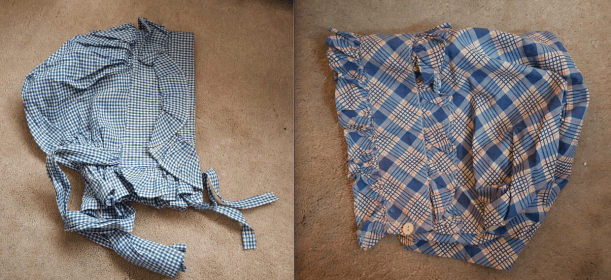
double_bonnet DRMy favorite is the more colorful one which has a smaller brim, no flounce and buttons instead of ties. Our mother used Maggie’s bonnets as patterns to fashion new ones to sell at church fundraisers.

Did you ever wear a sunbonnet? Do you have a sunbonnet story?

================================

More about Willis
For such a small town, it has made the news more than a few times.
1887 fire took out the Trompeter building and six others. Lots of buildings were destroyed by fire in the following years.
1912 train wreck and fire burned down the depot.
1938 Alf Landon, Ex Governor of Kansas and presidential candidate was speaker at the 4th of July celebration with 1500 people present to hear his address.
In 1946 the middle grain elevator had the top knocked off when it was hit by a Navy plane, resulting in the death of the pilot.
In June 2014 high wind amid powerful storms derailed 52 cars of a 134-car coal train which had stopped because of a tornado warning.

Leave a comment

Every Photo Has a Story:Grandpa Plays Checkers

1899 checkersNot every story from long ago has a photo

but every photo has a story.

1898 was a difficult year for my grandpa. In January, his 38 year old wife died after a long battle with TB. He was left to care for their two girls, ages five and three. A month later he buried his mother.

It was a dry year and there was no grain for the family, no hay for the livestock. Grandpa  and his brother-in-law decided to combine their stock and drive the herd to the valley of the San Joaquin River, a long and difficult trek to find salt grass pasture where the animals could forage. When the following year brought good rainfall they resumed their grain farming.

This photo, taken in Grandpa’s handsome two-story home during that year of hardship and sorrow, shows him cheering the neighborhood children. It reveals the interior, clothes, and hair styles of the Victorian era. Grandpa’s sister stands by while his oldest girl clings to him. His littlest kneels close to the checkerboard. What is special to me about this scene is Grandpa’s expression. Every eye is on the game. All except Grandpa’s. Is he challenging his opponent to consider her next move? Is he about to move his piece to end the game? What do you think?

During his wife’s illness, her sister took care of her and the children. She was like a mother to the two little girls, so it was no surprise when the aunt they loved became Mother, Grandpa’s second wife. They had two children, one of which was my dad. And that is another story!


Leave a comment

Taking Her Senses

The young woman had paid two dollars for a fountain pen and ten cents for a bottle of ink. She carried 200 blank forms which, by the end of the day, felt like a ton of lead. Summoning courage she approached each door, never knowing what to expect. Foul smells, foreign words, curses, and jabs to her face were not uncommon receptions.

At one house she received an offer of marriage from a recently widowed man. At another she faced a woman shopkeeper, her sleeves rolled high and arms akimbo. “Not one word do you find out from me,” the shopkeeper said. “Let them send a man who knows his business if they want to take my senses.” It was 1890 and the young woman wondered if it was worth the $20 she would be paid for her job as a census-taker.

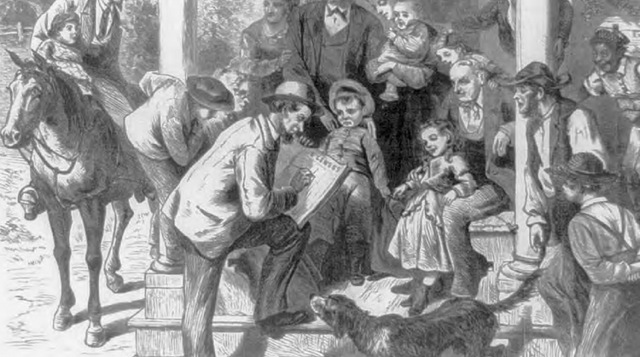
Census_TakerMale enumerators had their own hardships. They often carried little bottles of ink in their lower left hand vest pockets. One man, while getting information, upset his bottle and ruined the household’s beautiful carpet. Many people distrusted them, thinking they were tax collectors.

Between 1790 and 1850, only the names of heads of households and the number of other members present were recorded in the census. Starting in 1850, the census bureau attempted to record every member of every household, including women, children and slaves. Until 1870 the census was managed by the US federal court districts. There was no self-identification, so the U.S. Census Bureau relied on local people who had knowledge of the residents to conduct the enumeration. 1880 is the first census that allowed women enumerators.

While researching census-taking for my novel set in 19th century England, I learned that the enumerator would distribute 100-200 schedules which were to be completed on “census day”. After a few days he returned to collect them and make sure they were properly completed. Many times, due to the high percentage of illiterates, he had to write in the information himself. Misspelled names like Emos for Amos and ages rounded off prove the census is not necessarily accurate. The enumerator only counted those who slept in the house the night before census day, so not every person in a family was registered with their household. This is true even today. Sometimes the census record brings more questions than answers.  A girl of about five years was counted with a different family down the road in the 1850 census. Why had she gone there that evening? Why had the widow, counted with the family on census night, come from a neighboring village? These are questions I answered (from my imagination, of course) in my novel.

Historians, genealogists and the average keeper of family history, aware of possible inaccuracies, thrill at the discovery of previously unknown data. You never know what you will find in these hand-written records, thanks to the unheralded enumerators. Trying to earn a few extra bucks they have become an important part of our history.

Leafing through aged locally published newspapers in the archives of our historical society, I came across an article in an 1890 edition entitled “Taking Her Senses” It caught my attention because of research I had done on census-taking in 19th century England for a scene in my novel. To me it was a 125 year old treasure. Were any of your ancestors census-takers in the 19th or 20th centuries? I wonder what wild stories they would tell.

The illustration is a contemporary drawing of a government census taker in 1870. (Library of Congress)


Leave a comment

No Voice

rose with watermark

The month of May. A time to celebrate new life. A season of beauty, renewal, hope.
A time to honor mothers.

A mother is one who has given birth to a child or a mother blessed through adoption. I am thankful for our son’s birth mother who allowed me the privilege of being his mom. A woman may be a stepmother, a foster mother, or a mother to many through nurturing rather than birthing. One who has miscarried is a mother with a baby in heaven. The woman whose womb held a tiny life ended by unnatural means is also a mother. To her I dedicate this poem.

NO VOICE

Dark
Warm
Safe

Here I grew from
A seed
To a form of perfect
Tiny parts.

You cried
When voices spoke of you in
Shame,
When they said
A girl can
Make the grades
Be top citizen in her class
Succeed in life
If only…

No longer safe
I cried out
From your womb, but
I had no voice
To shout that shame
Would fade
But guilt would linger
A lifetime.

Voices spoke
In whispers
Calling him doctor.
Murderer was his name.

The cold hard metal
Sucked me from your womb.
Piece by piece.
Blood. Blood. Oh the horror!
The deed was done.

Your song
Mournful.
Your words
“Forgive me.”

Paradise.
A bright and happy place.
Safe at last
With others
Like me.
Too many.
Too many who had no voice.

You gave me no name.
Never knew if boy or girl.
Never knew
My beauty like you.

Guilt ridden
You wondered,
You remembered
The deed, the loss.
Too many years.

Along life’s way
You received the gift
of
Life eternal.

Your body,
Crippled and aged
Expelled its last breath,
Passed through the narrow way
To the gate
Where I was waiting for
Arms that could have held me
In life.

They hold me now
For eternity.
No tears.
We are one
At Peace.

Across your forehead
Your new name.
Forgiven.

You gaze at mine.
I do have a name after all.
My name is Grace.


Leave a comment

A Different Kind of Road Trip

Matts_orange_VW1

The two of us hit the road on a cold misty morning. My VW beetle and I have been many places together but this time is different. Its orange paint is peeling and the body has more than a few dents. Its upholstery has seen better days. The headlights are stuck on dim, but that is not a problem. We won’t be out after dark.

I throw my bag with a few essentials on the passenger seat and settle behind the wheel. It takes more than a few turns of the key to get going, but I relax at the familiar hum, like a lawnmower in summer.

The road we take is much like my life has been. Straight for the first few miles, then lots of twists and turns and a long uphill grade which slows us to a crawl. I wave my arm out the window to signal the car behind to pass. It seems people are so impatient these days. Why don’t they slow down and enjoy life?

Why is that horn blasting at me? Oh dear, that poor driver, having to swerve.

On the descent, I crank down all the windows and let the wind blow as it will. I feel as free as the wind that caresses my face and musses my hair.

The radio stopped working long ago so I sing my own songs, humming when I get to parts where the words don’t come to mind.

Was that a stop sign at the intersection? Oh dear! Too late now. Lakeside Park should be around the next corner, but I don’t recognize the cross street. Did I miss a turn? I pull into an unfamiliar parking lot, turn off the engine and sit in silence. My son said to call if my old car ever gives me trouble. I notice the arrow on the fuel indicator points to empty. That looks like trouble to me.

From the glove compartment I retrieve the small phone and push the button my son painted bright orange “in case you need help.” He scolds me for going off alone, for driving at all, even if Lakeside Park is only five miles from home. He will ride his bike here, he says, then drive me back.

I am heartbroken. Today was our last trip together, me and my orange bug. Tomorrow is my birthday. Tomorrow my driver’s license expires. My son is moving me into a big place with lots of residents. He insists I will be safe and happy with nutritious meals and lots of activities and friends and a bus to take me places. They tell me that at 89 years old I deserve it.

Life will not be the same without my friend. It is not quick to start or fast along the open road. Neither is it beautiful and shiny like it once was, but it got me places. And another thing, it would never tell me I was too old to drive.

Goodbye, dear friend. I will never forget the fun you and I have had and how we have grown old together.

More than three million drivers in the U.S. are over age 85. Most have probably been good drivers for years, so when we hint to a parent that the time has come to hand over the keys, especially for her own safety, she naturally resists. How hard it must be to feel the loss of independence. I hope by the time I am up in age, self-driving cars will be the norm. They will be keyless and “handing over the keys” will be a thing of the past.

Copyright by Danyce Gustafson 2015


1 Comment

One Christmas in Africa

Boke_house

The harmattan wind sent gritty sand swirling through the yard as the oppressive heat sent me back to the kitchen to refill our water glasses. “Where’s Son?” I asked Husband who reclined in a rattan chair on the veranda trying to cool himself with a wet rag to the head. He sat up when I offered him the warm glass, then tipped his head toward the store room door which was closed.

Little tappings sounded from inside where our six year old engineer had secreted himself. It was December 24th.

Our son seemed to accept that Christmas was not celebrated in this region of West Africa. No stores beckoned holiday shoppers with colored lights, fake snow, and music blaring words about a white Christmas or decking the halls with holly. No icicle lights blinked from the eaves of our house. There were no fir trees to decorate, no tinsel, Santa Clauses or reindeer. None of that had to do with the real meaning of Christmas anyway, but I admit that while I did not miss the commercialism, I did miss some of my childhood traditions.

A few days earlier, gazing at our sparsely furnished sitting area, I had asked Husband, “Is there something we can do to make our place a little more like…well…like…

“…like Christmas when we were six?” He finished my thought as he peered through the screened window opening at a scene so unlike the winter landscapes we had known.

“What about presents? Son should have something to open on Christmas morning.”

“Maybe we can find something at one of the village shops,” he said.

That’s great for dried fish or a bag of sugar, but certainly not something for a little boy, I thought. I wiped the sweat off my forehead and contemplated our family tradition of hanging stockings on the fireplace.

A short time later, while I was busy kneading dough for sweet bread, I heard the door slam shut. “Here’s our tree!” Husband said, proudly holding up the pathetic remnant of a thorn bush.

“Good start,” I encouraged. “Now if we could just have a fireplace. Not the warmth of it, of course. Just a place to hang our socks.” Wishful thinking in the heart of tropical Africa.

A few days before Christmas, Son fabricated tree decorations from odds and ends he found inside and outside the house. And who knew that Husband would take my wish to heart? He and Son fashioned a large piece of cardboard into a three dimensional fireplace complete with yellow and red paper flames. We hung three white socks and laid a small rag rug in front of it. I placed a red candle and our advent storybook on the mantle. I stepped back and thought, It’s almost perfect.

Christmas morning arrived and I began preparing a simple dinner to share with a Canadian family who lived down the path. Later we would celebrate Christ’s birth with a few of our favorite carols and scripture reading.

Husband called me away from the kitchen to pose the three of us beside our Christmas “tree” in front of our homey cardboard fireplace with its roaring paper flames. After a couple of camera shots, we took turns opening Christmas cards and letters from family and friends a world away. I held back tears. Son opened a package from his grandparents-two hot wheel cars. Next he pulled off the brown wrapping of the gifts we bought from a local shop–a bag of marbles and two giant balloons.

One package remained under the tree. “It’s for all of us!” Son exclaimed, presenting it to us. My husband and I smiled with pride, knowing he had put a lot of time into this special gift.

“Go ahead, you do the honors,” Husband said, placing it in my lap. I lifted the top of the crudely nailed wood box and peeked inside. Amidst wadded up toilet paper, I gently withdrew several clothes pegs dressed with raffia and ribbon. Mary, Joseph, the wise men, an angel.

“It goes like this,” Son said, turning the box on its side and placing the clothes peg people inside what resembled a stable. He left the room and brought back a few small plastic animals, even his rubber Pluto which he added to the scene.

“Thank you,” I said, giving him a big hug.

“But there’s more, Mom.” He plunged his hand into the pile of wadded paper and pulled out the bottom part of a match box. Inside was half of a clothes peg swaddled with a tiny blue cloth. “Baby Jesus in a manger,” he said, setting Jesus between Mary and Joseph. The scene was now complete. We marveled.

What a remarkable gift!

The babe, that is. Emmanu-el, God with us. God incarnate. Redeemer.

That is why we had come. To bring this good news to people who had never heard the wonderful message of salvation through Jesus Christ.

On that hot, humid December morn the message of Christmas rang strong and true. Our completeness is in Christ alone.
Our Living Hope!

Afterthought: Son kept the cardboard fireplace in his bedroom for most of the next year, but the memory of that Christmas will linger forever.


2 Comments

The Blacksmith

anvil

“A dull ring drew Richard’s attention to a leather-aproned blacksmith smiting black iron on the anvil. The bellows roared as the man pulled the iron from the forge that glowed red, orange, yellow, and white, but Richard had no time to watch him shape the hot metal with his hammer and return it to the fire for remolding.

He hurried on, contemplating how heavy iron pieces could be turned into kettles, shovels, hooks, and knives–and how old tools could be shaped into new ones.”
(excerpt from “Stone’s Hope”)
Denny Chester, blacksmith shop_small
Denny Chester, circus farrier

In the early 1900’s, when my grandpa was fourteen, he started working in his father’s blacksmith shop. A few years later he ran his own business shoeing circus elephants and horses used by the fire department. With the introduction of automobiles, like other blacksmiths at that time, he joined the first generation of auto mechanics.

As a blacksmith, Grandpa’s work bench was the anvil where he positioned the metal to be forged. His tools were the hammer for forming, the chisel and hardy for cutting, and tongs for holding the hot metal.The slack tub for cooling the hot metal and controlling the fire was close by.

He would place the workpieces in the fire until it was malleable and ready for shaping by the impact of the hammer. To bend pieces, he hammered the metal over the anvil’s edge, or by the processes referred to as drawing and upsetting, he was able to refine the metal into different shapes.

To begin with, the metal was useless in itself, but applying a very hot fire and lots of hammering, the smith formed useful tools, vessels or horseshoes. If the product was not right, back it went into the fire until he was satisfied. He even remade old tools and vessels by the same process of heating and hammering.

It makes me wonder how similar I am to that unbending piece of iron that God wants to use. Am I willing to let Him place me? Can I accept that the fire is for making me pliable so the hammer can then shape me into a tool usable for His service? The anvil, fire and hammer do not appeal to me, but neither do I want to be useless. Who better to submit to than the master smith? In His hands I can be assured that His work is perfect.


Leave a comment

When The Tide Goes Out

kyomegirl's avatarDani's Niche

books_on_shelfHave books ever spoken to you? I don’t mean”speak” in the usual way by content that informs, challenges, encourages, or inspires, but rather … well, let me back up a bit.

Like most writers, I get discouraged from time to time. It’s not easy writing historical fiction. I need to come up not only with the right words but with accurate history. Sometimes I simply get stuck. Many call this writer’s block. I call it the “ebb.”
Writing reminds me of the ocean tide. The waters go out to sea but they always come back. So also, there is an ebb and flow in writing. On rare occasions, the waters recede very far and all is silent for a longer time than usual, but just because the tide has gone out does not mean it’s going to stay there. In fact, the longer it stays, the more forceful is its…

View original post 178 more words


1 Comment

When The Tide Goes Out

books_on_shelfHave books ever spoken to you? I don’t mean”speak” in the usual way by content that informs, challenges, encourages, or inspires, but rather … well, let me back up a bit.

Like most writers, I get discouraged from time to time. It’s not easy writing historical fiction. I need to come up not only with the right words but with accurate history. Sometimes I simply get stuck. Many call this writer’s block. I call it the “ebb.”
Writing reminds me of the ocean tide. The waters go out to sea but they always come back. So also, there is an ebb and flow in writing. On rare occasions, the waters recede very far and all is silent for a longer time than usual, but just because the tide has gone out does not mean it’s going to stay there. In fact, the longer it stays, the more forceful is its return. Like a tsunami the waters come rushing back with great power. When my tsunami comes I can’t type fast enough.
Recently I found myself in the ebb stage. That’s when books spoke to me. They were random books pulled from my shelf for a photo shoot — a little bling to enhance the facebook post for my newly published novel. After changing a weak battery in my camera and getting the light just right, I took the shot. Then I downloaded the picture and viewed it on my computer screen. Whoa! It was a photo of a stack of books, yes, but also a message of encouragement just for me.
Did the books speak to you too? Perhaps, but real hope is found not in a book or on a book. It is found in a person–Jesus Christ. The Bible is full of more messages of hope and encouragement than any book ever written. “May the God of hope fill you with “a tsunami of” (or all) joy and peace as you trust in Him.” (Romans 15:13)


2 Comments

Simple Pleasures

A simple pleasure is never far away

Ready to brighten the day In a most ordinary way.

How sad that something

Once a pleasure

No longer seems like such a treasure.

There was a time long past

In Africa.

A young woman walked dusty paths, village to village, with sandaled feet bringing good news to those who never heard the name of Jesus. At day’s end she washed her tired, dirt covered feet in a small tub of rain water. Her head and body prickled with dirt and sweat and she longed for  a cold shower or even a bucket shower, but this would have to do. A simple pleasure.

She felt isolated from her family and friends half a world away. Having no phone, e-mail, or daily mail service, she learned to wait. When the mail bag finally arrived she took her letters to a quiet place. She knew from the handwriting that these were letters from home–from family, friends, and people she had never met. Others never wrote. Nothing special to share was their excuse. They did not understand that everything she read in those letters, even the most mundane to them, connected her to home. After each letter was opened and read, she leaned back in her chair and thanked God for the sender. Her heart was stirred, encouraged and cheered and she was reminded of  the proverb, “Like cold water to a weary soul is good news from a distant land.” A simple pleasure. Now she rarely thinks about those past pleasures. It’s not that she doesn’t appreciate hot and cold running water at the turn of the faucet, not having to check her shoes for scorpions, and the luxury of phones, email and social networking to keep up with family and friends. Now, perhaps, she has come to expect them.

What are your simple pleasures?


2 Comments

Let it Resound!

clouds_for_blog_cropped

The conductor bows, turns to face the orchestra, and raises his baton. At the first strain of the Firebird Suite I am swept up by the aggressive and lyrical movements portraying the luminous firebird, the prince, and the beautiful Elena.

Next, the orchestra performs a symphony followed by their final piece, the Russian Easter Overture, inspired by the passion of Christ as told in the Gospels.

I watch black clad musicians seated in chairs, their quick finger movements creating warbles and wails from tiny piccolos. Throaty, beseeching sounds from the trombones, and a brilliance of color from clarinets and saxophones, oboes and bassoons waft through the auditorium. A minor key evokes the somber crucifixion scene.

Percussionists stand behind the euphoniums and tubas. Their parts are intermittent but elicit great emotion. The rhythmic, boom of the tympani spreads to the other instruments, echoing the uninhibited rejoicing at the resurrection of Christ.

While other musicians puff into mouthpieces or send lithe fingers over keys and tiny holes, one musician seems idle. He waits, never taking his eyes off the score in front of him, turning page after page but never producing any sound from his instrument.

The music builds to a crescendo. The piece is nearly finished and the musician still waits. Then high in the air he raises up two round metal pieces, thrusting them together with a loud, resonating crash. My heart surges. He opens his arms wide with the cymbals facing the rapt audience and lets the sound slowly dissipate. The music concludes, the sound of the cymbals continuing to echo in my heart and mind.

One instrument of many in the orchestra of life.  A moment in time. A purpose fulfilled.

Let it resound to the nations. Let it resound for all to hear.

He is risen! One purpose fulfilled. For all mankind.

One day all instruments will resound in praise to God on high!